# Overview

GPU financing through USD.AI is available via GPUloans.com, a dedicated borrower-facing portal powered by the USD.AI protocol. USD.AI provides institutional-grade GPU financing for neoclouds and AI infrastructure operators. The full loan process, from purchase order through funding, hardware delivery, installation, and ongoing repayment, is structured through a pre-closing flow of funds designed for security and clarity.

### **Loan Process - Flow of Funds**

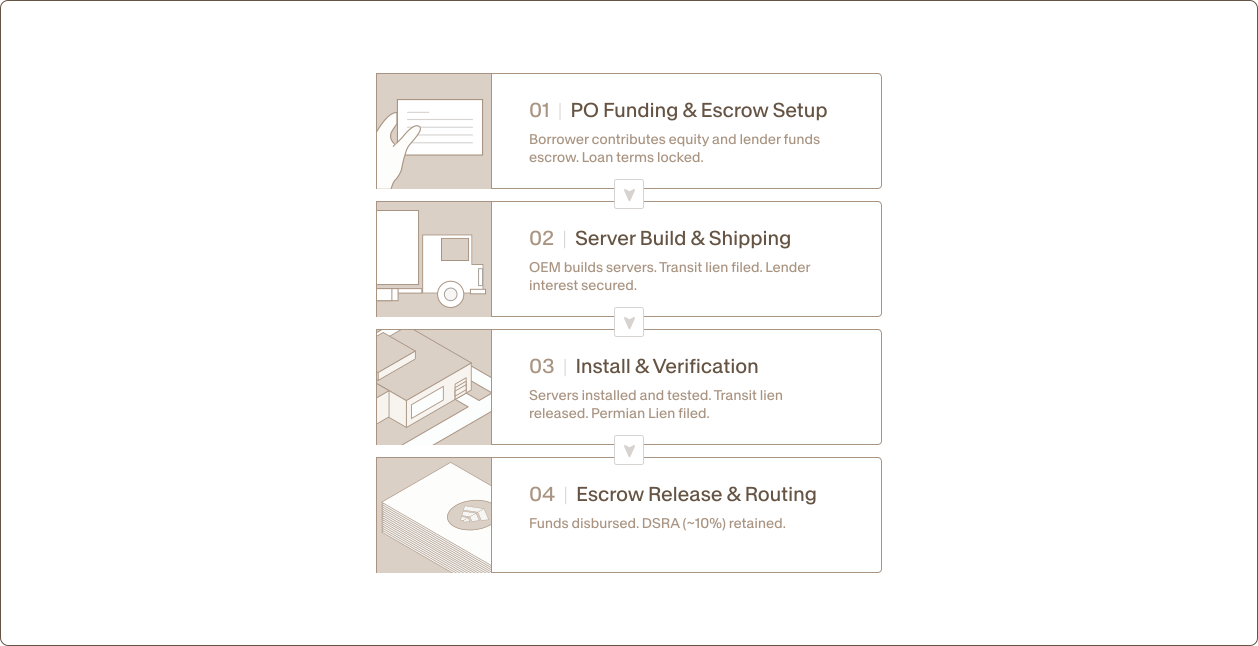
From purchase order to permanent debt, every USD.AI loan moves through a structured four-phase flow of funds designed to protect all parties and ensure clean legal title at every step.

<figure><img src="https://1324162391-files.gitbook.io/~/files/v0/b/gitbook-x-prod.appspot.com/o/spaces%2FyihtTguEhuWiLBn09qwl%2Fuploads%2FoCPPdubFfLaiF21aZUbx%2FPre-Closing%20Flow.svg?alt=media&#x26;token=8043af96-0f5f-4a1e-a751-5eda3c62c9f1" alt=""><figcaption></figcaption></figure>

#### Phase 1 — PO Funding & Escrow Setup&#x20;

Before any hardware is shipped and installed, USD.AI establishes a secure funding structure, to protect both the borrower and lender throughout the transaction. Typically, USD.AI uses escrow to safely fund every loan. Wilmington Trust, National Association serves as the independent Escrow Agent, holding loan proceeds in segregated, per-loan accounts. At the moment of escrow funding, yield begins accruing on the loan, at a lower rate than the drawn rate (typically 5-7%), adequately covering carry costs of capital during the escrow period. Funds are only released once all required parties have authorized the disbursement in writing, ensuring no single party can move capital unilaterally. In some cases, borrowers who have existing net 30 terms with their OEM or who are working directly with a bridge lender may not require escrow.

Where escrow is used, the borrower deposits their equity contribution directly to the Ordinary Equipment Manufacturer (OEM). The lender (GPU Finance Ltd.) then funds the escrow, which is held until hardware delivery and verification are confirmed.  A digital record of the loan terms is created in a pending state before any hardware ships, ensuring all borrowing terms are documented and locked in from the outset.

#### Phase 2 — Server Build & Shipping

OEM builds and prepares the servers for delivery. During transit, the Bridge/OEM files a lien against the server assets, securing the lender’s interest in the hardware before it arrives at the datacenter. Lender provides a guarantee to release escrow upon successful installation and verification.

#### Phase 3 — Install & Verification

Servers arrive at the datacenter, and are installed, tested, and verified as operational. The Permanent Loan Agreement is executed. The transit lien is released, and the lender simultaneously files a new permanent lien against the installed hardware, establishing clean, senior collateral rights before the escrow is closed out.

#### Phase 4 — Escrow Release & Fund Routing

Once all required parties have authorized the release, escrow is closed out and funds are disbursed. Net proceeds are routed either directly to the Bridge Lender or to the Borrower for direct payment, depending on the deal structure. A Debt Service Reserve Account (DSRA), approximately 10% of the gross loan amount, is retained from escrow at closing as a repayment buffer.

**Net Proceeds = Gross Loan Amount – Closing Fees – DSRA Reserve**

Post-closing, the bridge is fully repaid, the lender holds a permanent lien against the hardware, and the loan enters standard ongoing operations. Borrowers who fund their DSRA in USDai are eligible for a reduced interest rate. See the DSRA & Rate Compression section below.

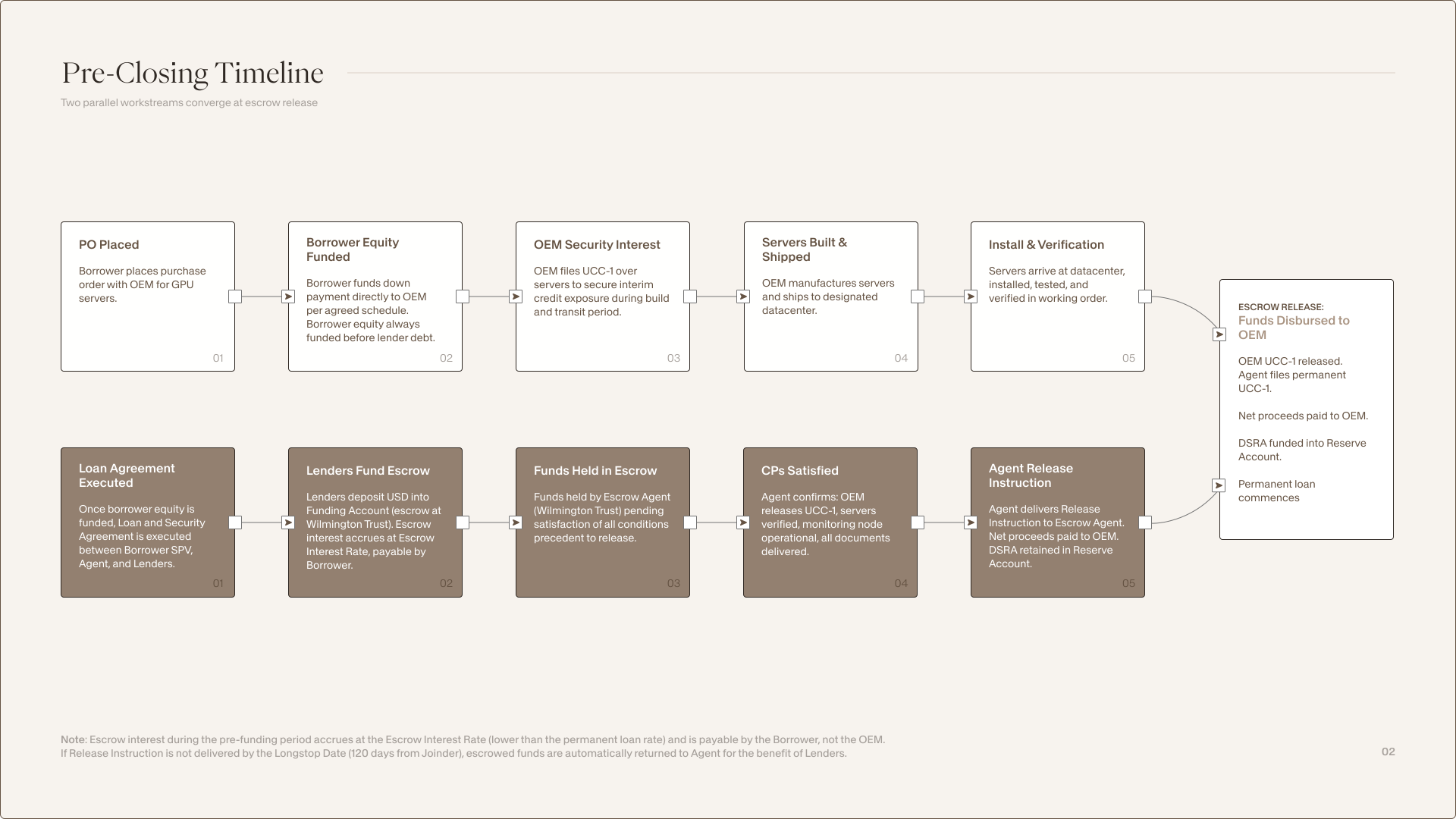
### Pre-Closing Timeline

<figure><img src="https://1324162391-files.gitbook.io/~/files/v0/b/gitbook-x-prod.appspot.com/o/spaces%2FyihtTguEhuWiLBn09qwl%2Fuploads%2FMEKkxIBkTp64K7BP2nun%2F2%20Pre.svg?alt=media&#x26;token=01d86498-fba5-4d07-857c-8746680d35ca" alt=""><figcaption></figcaption></figure>

### Illustrative Sources & Uses at Closing

<figure><img src="https://1324162391-files.gitbook.io/~/files/v0/b/gitbook-x-prod.appspot.com/o/spaces%2FyihtTguEhuWiLBn09qwl%2Fuploads%2FlGgY1xZu5TJtwRhdVgI1%2F3%20Sources.svg?alt=media&#x26;token=4a814ac4-4b04-46a8-b69e-0eeb87790f9c" alt=""><figcaption></figcaption></figure>

### Key Parties

<table><thead><tr><th width="209.75390625">Party</th><th>Role</th></tr></thead><tbody><tr><td>USD.AI Foundation</td><td>Cayman Islands Foundation Company. Parent entity of the protocol; acts as Tokenizing Agent for GPU loans and manages ecosystem partnerships that expand borrower access to hardware, financing, and infrastructure networks.</td></tr><tr><td>GPU Finance Ltd.</td><td>Subsidiary of the USD.AI Foundation. Acts as Administrative Agent and Lender on all loan agreements; enforces events of default and manages collateral on behalf of protocol depositors.</td></tr><tr><td>Permian Labs</td><td>Delaware corporation. Technical and operational service provider to the Foundation; built the original protocol and provides day-to-day engineering, deal origination, and operational support. </td></tr><tr><td>Bridge</td><td>Gap financing provider. Funds the purchase order period and is fully taken out upon escrow release at closing.</td></tr><tr><td>Independent Custodian</td><td>Third escrow signatory. Provides independent oversight of the escrow release process.</td></tr><tr><td>OEM</td><td>Original equipment manufacturer. Receives the borrower's equity deposit directly and builds/ships the servers.</td></tr><tr><td>Datacenter</td><td>Warehouses and custodies the GPUs; provides power, cooling, connectivity, and security.</td></tr><tr><td>PayPal / Paxos Trust Company</td><td>PayPal provides the payment infrastructure and lending currency used across USD.AI loans. Paxos Trust Company (NYDFS-regulated) ensures the currency is fully backed 1:1 by U.S. dollar deposits and short-term Treasuries, with monthly third-party attestations, giving borrowers confidence that the funds they receive and repay are stable and fully redeemable.</td></tr><tr><td>Borrower</td><td>Bankruptcy-remote Delaware LLC SPV; sole purpose is to own the GPU collateral and borrow under the loan</td></tr><tr><td>Parent / Operator</td><td>Operating company that contributes the servers to the SPV and acts as Limited Guarantor</td></tr><tr><td>Independent Manager</td><td>Third party service provider required to consent to Material Actions taken by the SPV (ie, blocks consolidation efforts)</td></tr></tbody></table>

### Legal Structure

Every USD.AI loan is supported by a complete, traditionally structured legal package. This includes:

* **Loan and Security Agreement** — governs all economic terms, repayment obligations, collateral rights, and default provisions between the borrower SPV and GPU Finance Ltd.
* **UCC-1 Financing Statement** — filed against the hardware assets, establishing the lender's priority security interest
* **SPV LLC Agreement** — the borrower holds GPU assets through a Special Purpose Vehicle, legally separating the collateral from the borrower's broader balance sheet.&#x20;
* **Sale & Contribution Agreement** — formally transfers the GPU assets from the operating company into the SPV, establishing clean legal title in the entity that holds the collateral.
* **Pledge Agreement** — pledges the equity interests of the borrower SPV to the lender as additional collateral, giving the lender recourse to the entire SPV if needed.
* **Limited Guaranty** — the borrower's parent entity provides a limited guaranty of the loan obligations, adding a layer of recourse beyond the hardware collateral itself.
* **Master Services Lien Waiver** — the datacenter operator formally acknowledges the lender's senior security interest in the hardware and waives any competing lien claims.
* **Customer Services Agreement** — governs the ongoing relationship between the borrower and GPU Finance Ltd. across loan administration, SPV setup, and operational support.

This infrastructure ensures that if enforcement is ever required, all legal rights are already documented, properly structured, and ready to act on.

### Loan Execution

Once the closing process is complete, the borrower receives loan proceeds and enters the standard repayment period. Repayments are due every 30 days in accordance with the loan terms, with a mid-teens APR and 3-year principal amortization.

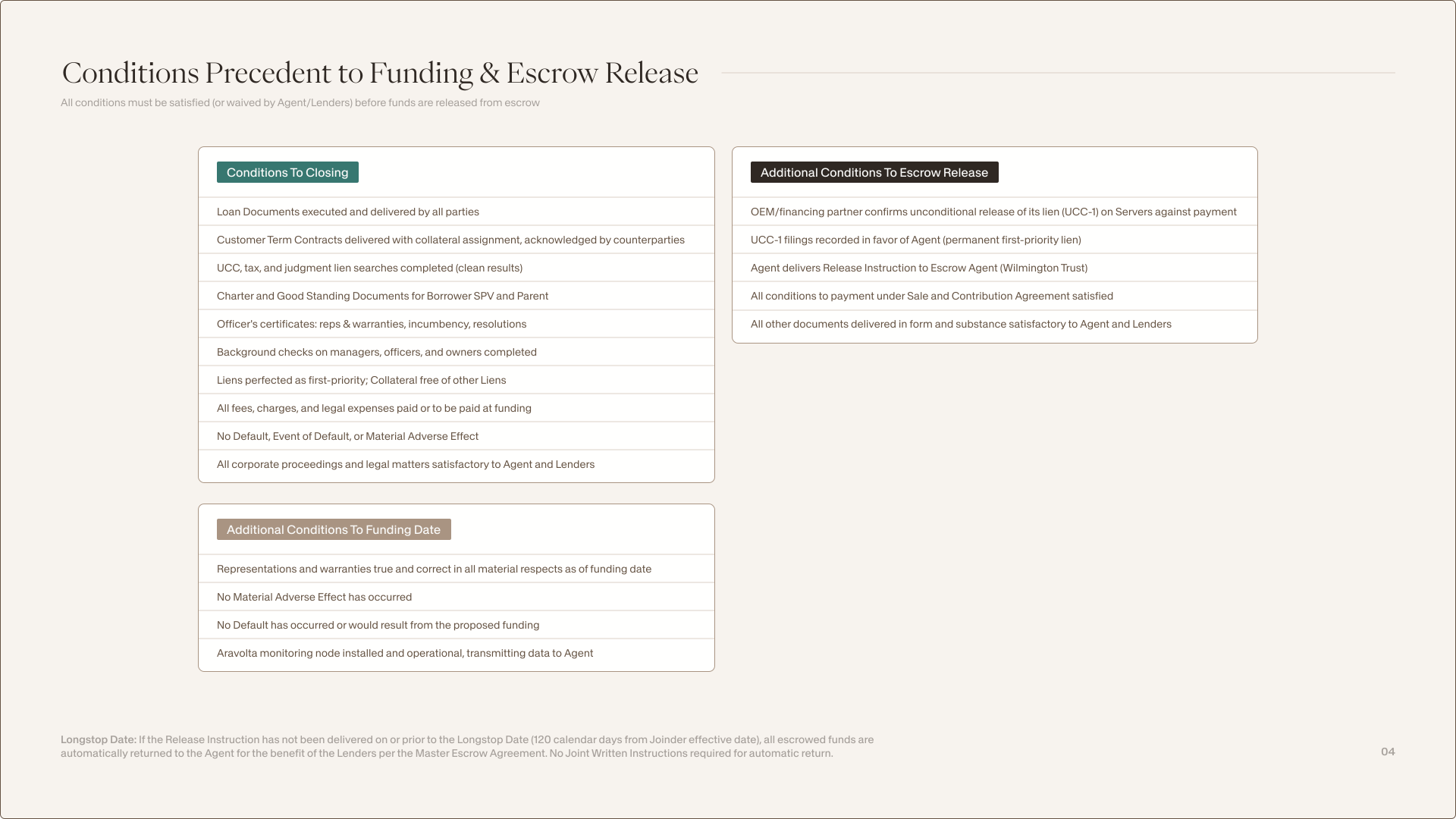
### Conditions Precedent to Closing & Funding

<figure><img src="https://1324162391-files.gitbook.io/~/files/v0/b/gitbook-x-prod.appspot.com/o/spaces%2FyihtTguEhuWiLBn09qwl%2Fuploads%2FMOEQVqk5qrYmf3YAIqYs%2F4%20Condition.svg?alt=media&#x26;token=203bd316-3c98-4a7b-93f1-5c53449e826b" alt=""><figcaption></figcaption></figure>

### DSRA & Rate Compression

All borrowers are required to maintain a **Debt Service Reserve Account (DSRA)** — a reserve funded at closing, sized to cover a defined number of interest payments in the event of a shortfall.

Borrowers who elect to hold their DSRA in **USDai** unlock a rate compression benefit: the protocol redistributes the passive yield generated by that USDai (via the PayPal 4.5% PYUSD incentive and T-Bill income) back into the interest rate calculation, reducing the effective borrowing cost. This mechanism is the foundation of the broader USD.AI payments vision — the more of the compute stack that settles on USDai rails, the lower the effective interest rate becomes across the network.

This is the first step toward a future in which GPU financing, counterparty settlement, and end-user compute payments all operate on a single, yield-generating rail.

### In the Event of Default

If a borrower fails to meet their payment obligations, (interest and principal every 30 days, with one 30-day grace period at an accelerated APR), or fails any other non-financial covenant, an event of default is triggered. USD.AI works collaboratively with the borrower to find a buyer for the hardware, drawing on partnerships with IT Asset Disposition (ITAD) firms who can physically retrieve and resell the GPUs if needed. If market conditions have compressed the hardware's value, Barkr's value reinsurance coverage activates to protect against unexpected depreciation, ensuring recovery value is preserved for all parties. This combination of ITAD operational capability and Barkr coverage means that default recovery is a structured, practical process rather than a theoretical one.

### In the Event of Borrower Bankruptcy

If the Borrower's parent entity enters bankruptcy, the assets backing the loan are fully walled off from other creditors. The SPV structure provides complete legal separation, the tokenized GPUs cannot be collapsed back into the Borrower's estate or claimed by other creditors as part of the bankruptcy process.

### Getting Started

Borrowing via USD.AI is not publicly available. Reach out to the USD.AI team through the following if you would like to inquire or get more information:

1. Visit [**GPUloans.com**](https://gpuloans.com) to review the borrower overview and submit an [initial inquiry](https://www.gpuloans.com/contact).
2. The USD.AI team will conduct preliminary diligence on your business, assets, and legal structure.
3. Upon approval, loan terms are presented and the four-phase closing process begins.

If you have any questions, please reach out to <originations@usd.ai>.

\
\&#xNAN;*\*\* Note: earlier iterations of the USD.AI design leveraged warehouse receipts in lieu of loan NFTs for asset tokenization. In all cases, bankruptcy remote SPVs are used to ensure asset isolation from parent, and financial loan terms are established via smart contract logic.*&#x20;

<br>

<br>

\ <br>